


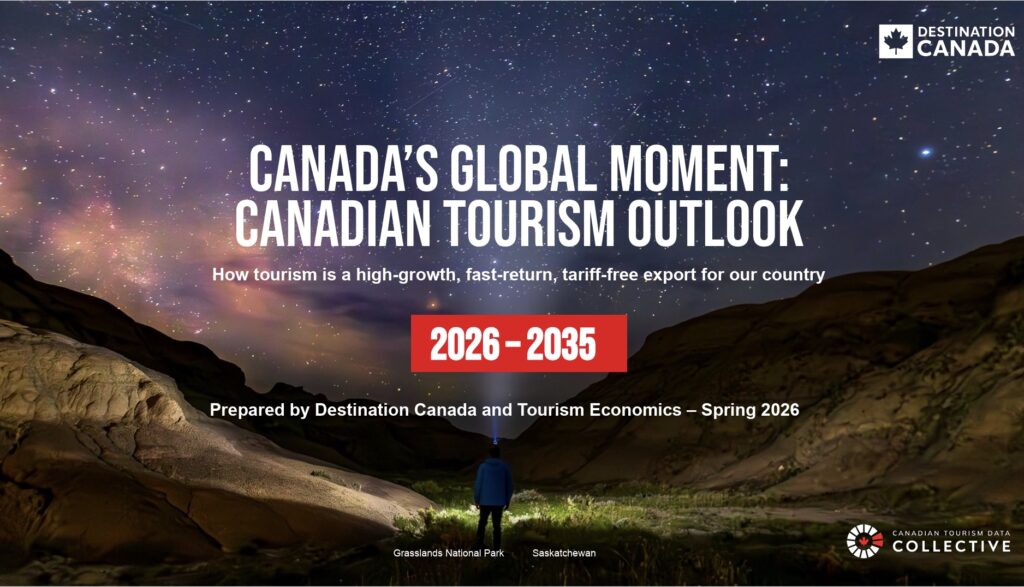
On April 22, Destination Canada released its 2026 Canadian Tourism Outlook report, highlighting continued growth and new opportunities across Canada’s visitor economy.
Below are five key takeaways, along with a link to the full report.
Key insights include:
- Canada’s Global Moment: Tourism will contribute to Canada’s Trade Diversification Goals: Tourism is projected to contribute 9-10% (up to $30 billion) toward Canada’s goal of securing an additional $300 billion in non-US exports by 2035. Tourism is one of Canada’s top service exports. Canada is in the race to seize a greater share of the USD $2.1 trillion global market for international visitor spending. (Source: World Travel & Tourism 2025 Economic Impact Research)
The Canadian tourism sector is set for a banner 2026, boosting the economy with $140.9 billion in projected visitor spending, up 6% from 2025. - Overseas markets are where diversification and export growth accelerate: The report confirms that overseas markets are the sector’s export acceleration engine. Forecast to grow 9.8% annually through 2035, roughly double the US pace. Overseas markets are helping diversify Canada’s demand base across markets and seasons while bringing more net-new money into local economies and creating a stronger long-term growth mix.
Destination Canada’s overseas markets include: UK, Germany, France, Japan, China, South Korea, Australia, Mexico. - The United States remains the cornerstone and largest international market: The U.S. remains Canada’s largest international market by a wide margin, and the Outlook still forecasts total US spending growth of 5.3% annually. But the stronger signal is yield: higher-value air arrivals are forecast to grow faster than land and sea travel, pointing to longer stays, broader exploration and stronger spend per trip.
- Canadians choosing to travel at home strengthening communities across the country: Destination Canada’s Outlook shows that the benefits of domestic travel are felt across the country. Canadians are increasingly choosing to travel at home, with reshored spending projected to add $1.5 billion in 2025 and $4.4 billion between 2025 and 2027. That demand is helping steady the sector and spread benefits across all 122 tourism regions in Canada.
- International business events continue to punch above their weight: Business events remain one of the sector’s highest-yield growth plays because they bring more than delegates. Tourism is often the first handshake to investment. The Outlook projects association events will reach 132% of 2019 levels by 2028, with delegates at 118%, while also strengthening trade ties, talent attraction, sector connections and long-tail legacy benefits for host communities.
Explore the full report here: https://www.tourismdatacollective.ca/tourism-outlook-2026-2035
